
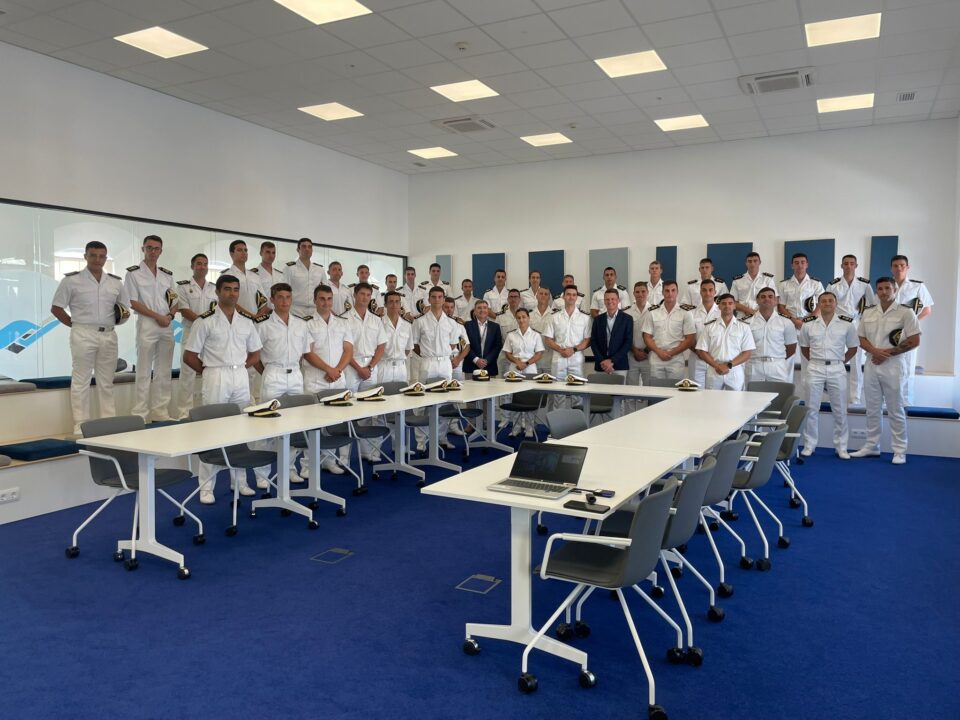
Last Friday, July 3, 2026, students from the 1st Brigade (ASP 1st) and the 4th Brigade (GGMM 2nd) of the Bachelor’s Degree in Mechanical Engineer taught at the Defense University Center at the Spanish Naval Academy (CUD-ENM), along with students from the 11th and 12th brigades of the Spanish Naval Academy, visited Navantia’s facilities at the Ferrol shipyard (A Coruña), accompanied by Professor Carmen Mariño Martínez.
The visit began with a reception during which the students were able to learn about Navantia’s facilities and their role in the company’s manufacturing process through a digital model.
Following this presentation, the group was taken on a tour through the building and had the opportunity to visit the technical office area. There, Mr. José Antonio Cabanas, Head of Engineering, and Mr. Juan Carlos Lata, Defense Programs Coordinator, provided an overview of the company’s more than 300-year history. The students were able to see how the company’s capabilities in the design and manufacture of defense vessels have evolved, making Navantia not only a strategic supplier to the Spanish Ministry of Defense but also an internationally recognized leader in the design and manufacture of military vessels for other countries.
Both managers emphasised the renewal process the company is undergoing, both in terms of its facilities—with the creation of a digital block factory and the development of the COEX Digital Twin—and in terms of its workforce, which has grown significantly to meet the challenges posed by today’s market.
The visit continued at the dock, where Mr. Santiago Camiño Tajes, captain of the F-110, gave the students a firsthand look at the assembly process for the first frigate in the F-110 series, the F-111. Mr. Santiago Camiño explained how the frigate is assembled, the technical challenges associated with this process, and the logistical organization required to coordinate the work with other participating companies.

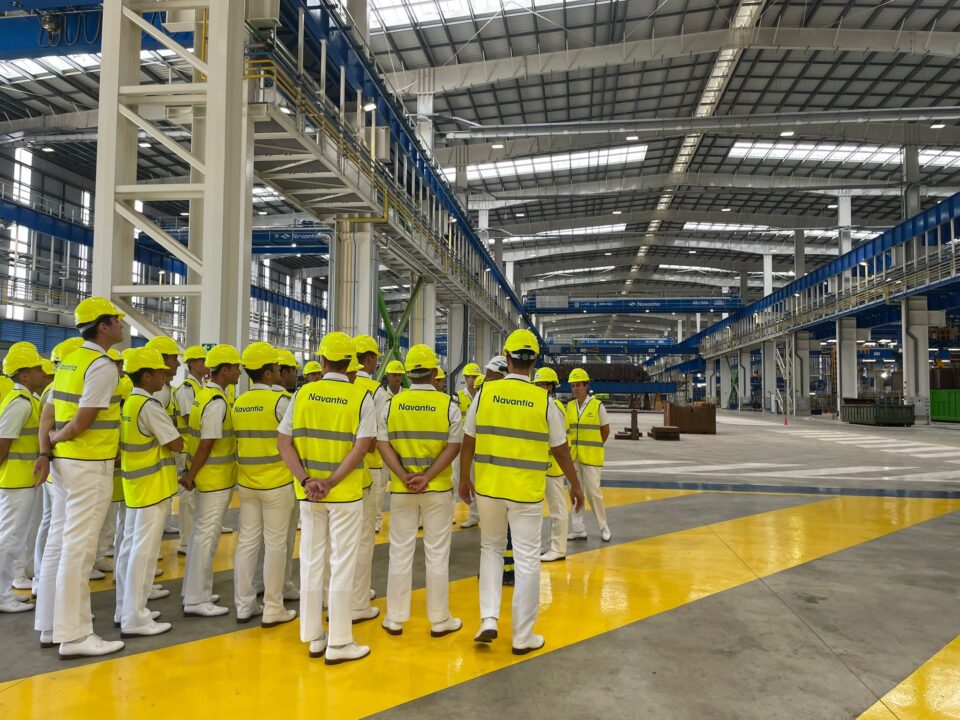
The group then went to the block factory, where Mr. Daniel Pereira gave them a tour of the entire manufacturing process for these components, which are essential to the construction of the frigates. The students were able to observe how steel profiles and sheets were transformed through cutting and welding operations into functional components, as well as the actual assembly of parts for the F-112 and F-113 frigates.
From the block factory, the tour continued to Station 3, where the blocks are assembled, and the students had the opportunity to observe the assembly of the F-112 frigate.
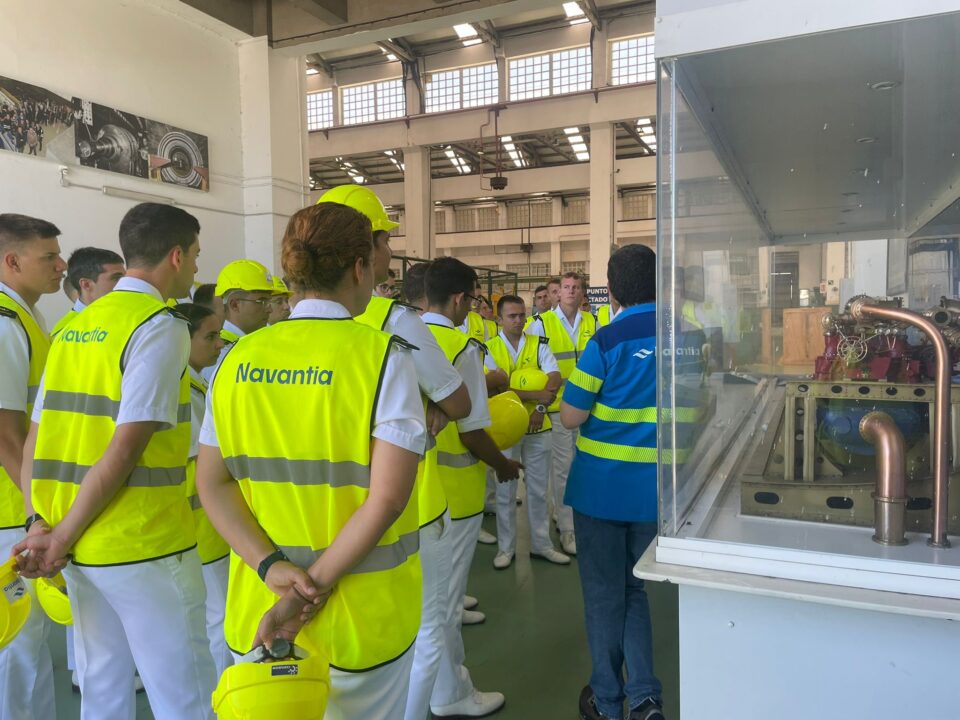
After learning about the boat-building process, the students also had the opportunity to learn about the turbine manufacturing process. During this part of the visit, they learned how this equipment works and discovered the main stages of its production process.
At the last stop, the group visited the Navantia COEX Digital Twin, where they learned about the state-of-the-art platform technology used to simulate different scenarios during the design and development phases. The students also attended a live demonstration of the center’s capabilities.
The tour of the Navantia facilities concluded with a light snack, during which the students had the opportunity to exchange views with Mr. José Antonio Cabanas and Mr. Juan Carlos Lata. The activity proved very informative for the participants, who were able to learn firsthand about the manufacturing process for the ships they will use in their future careers.